INTRO UNDERSTANDING THE CONTEXT LISTENING TO PEOPLE OBSERVING FOODSCAPES
CRAFTING INSIGHTS DESIGNING INTERVENTIONS

Once key foodscapes challenges have been identified, the next step is to begin designing interventions that respond to those challenges and support healthier everyday behaviors. Foodscapes interventions can take many forms, from public realm improvements to food access programs to policy changes.
Designing Interventions
METHODS IN THIS SECTION
→ Identify Local Partner(s)
→ Select a Site
→ Brainstorm Interventions
→ Combine Interventions for Greater Impact
Identify Local Partner(s)
Effective interventions build on existing community assets and are developed collaboratively with local stakeholders. Prioritize partnerships with organizations and individuals who understand the lived experience of local foodscape challenges and have strong community relationships. It can also be valuable to work with entities that control potential intervention sites, such as city agencies, market owners, or vendors, to support implementation and long-term stewardship.
Select a Site
The location of an intervention can strongly influence its success.
Consider:
Equity: prioritize interventions in underserved neighbourhoods that experience the most severe foodscape related challenges.
Exposure: intervene in places people already pass through regularly, like transit hubs or community gathering spaces.
Opportunity for behavior change: prioritize locations where unhealthy food environments dominate - or alternatively, focus on places that already have a great food offer but are struggling to attract people.
Also consider at what scale interventions will be most impactful: a block, a neighborhood, across neighborhoods, etc., in relation to the identified target group and needs.
Intervening in public spaces (e.g., outside a school, along a commercial street) often carries the potential for reaching the widest range of potential users.
Worksheet
Theory of Change: Step 2 (Solutions)
This worksheet uses an Issue Tree to help teams move from research findings to actionable ideas by identifying key foodscapes challenges, the underlying drivers behind those challenges, possible interventions, and the desired behavioural changes those interventions aim to support.
Estimated time: 1 hour
Example Foodscapes Interventions
A collection of example foodscapes interventions from different contexts, including intervention descriptions, key challenges addressed, and implementation considerations. These example interventions are intended to inspire locally grounded ideas and support teams in identifying projects that align with their own goals, capacities, and communities.
Estimated time: 30 minutes
Brainstorm Interventions
When brainstorming ideas, focus on interventions that address the root drivers behind food behaviours — not only the behaviours themselves. For example, if you have observed that people rely on unhealthy convenience food because they are short on time, interventions might focus on integrating healthy options into commuting routes or daily travel patterns.
You can use the worksheet "Theory of Change: Step 2 (Solutions)" to help you do this.
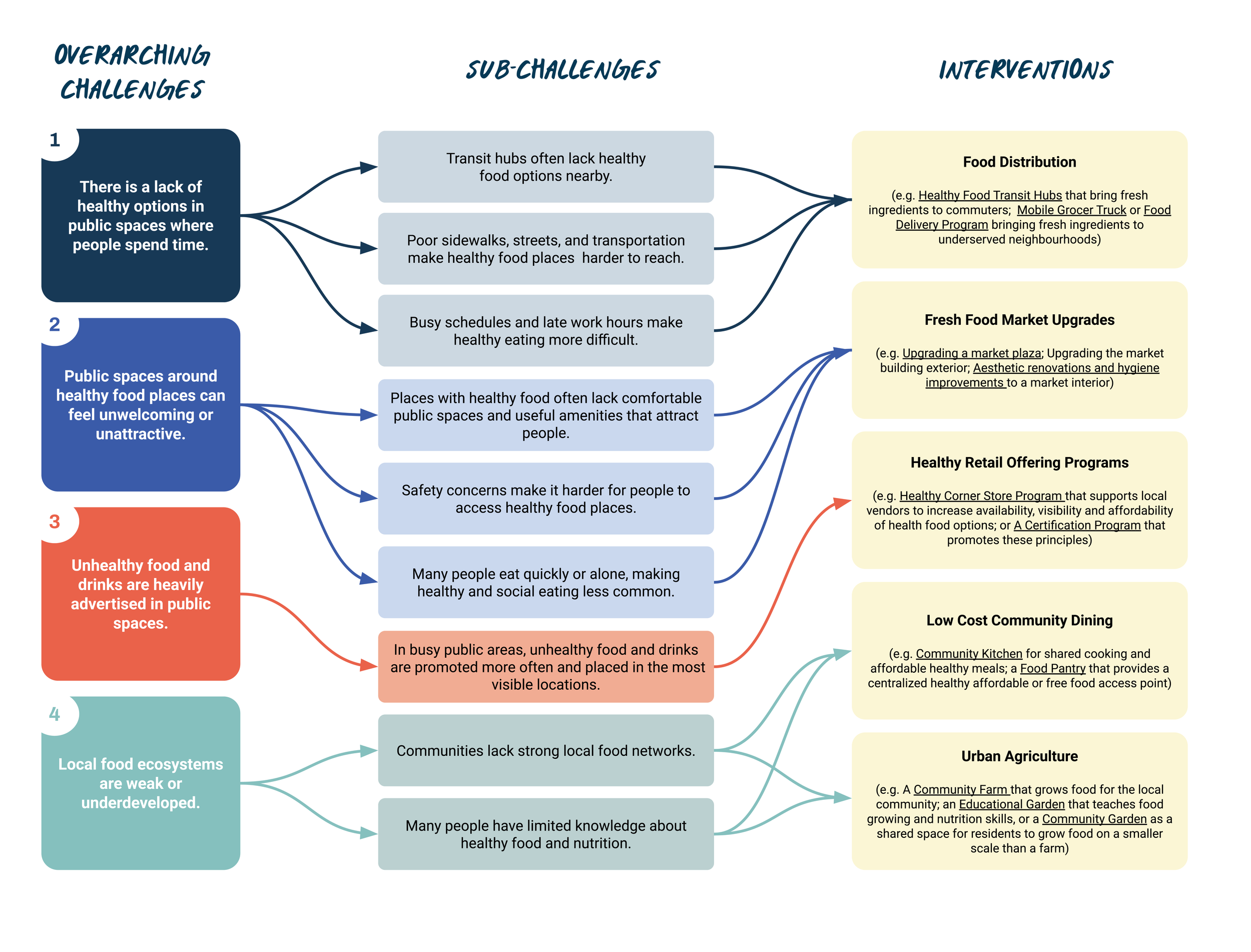
Work with community members and intended beneficiaries to identify and shape interventions. Co-design and consultation processes can help ensure interventions reflect local priorities, lived experiences, and everyday realities.
Combine Interventions for Greater Impact
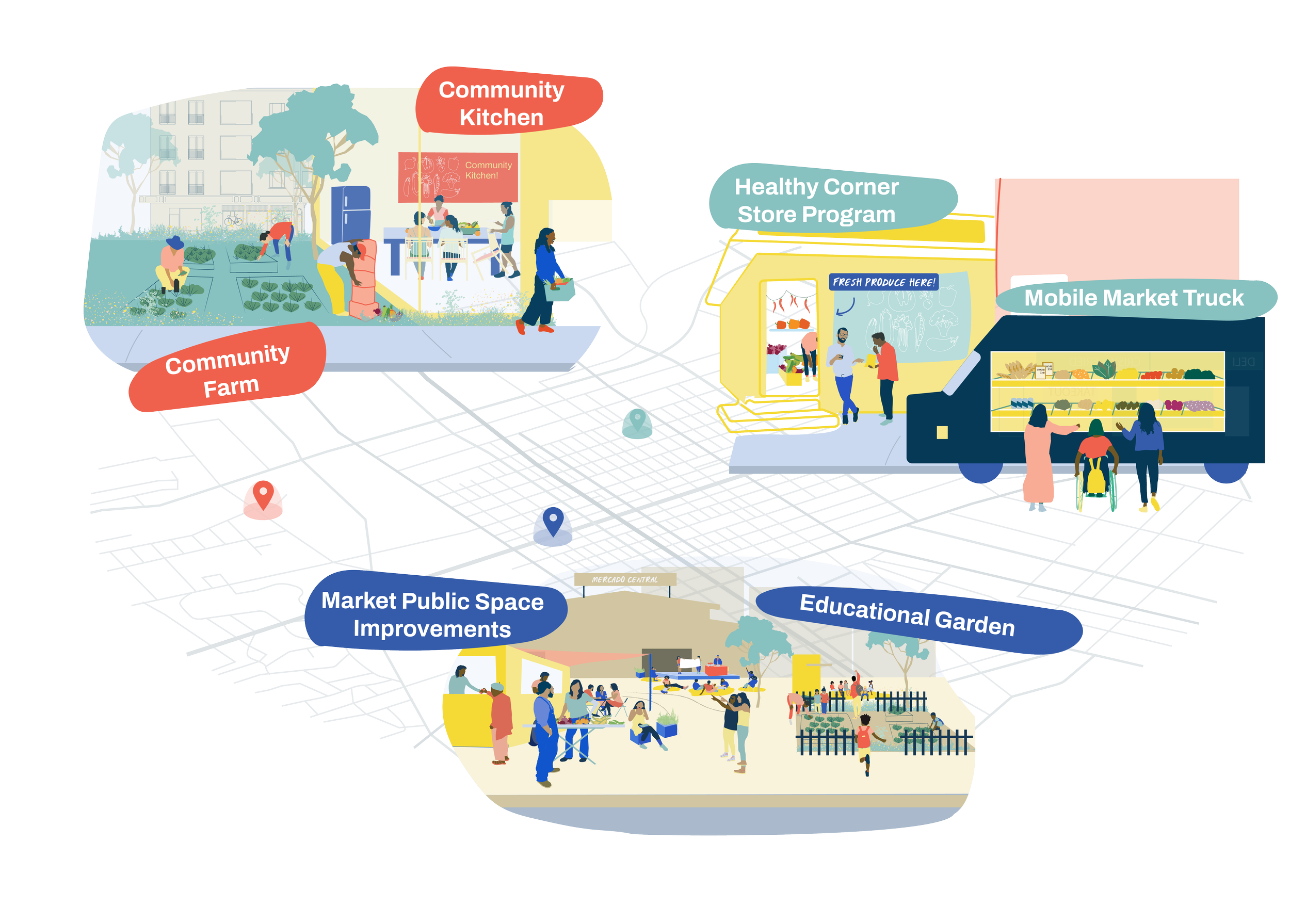
Food behaviours are shaped by many overlapping factors. As a result, interventions are often most effective when multiple strategies are combined or co-located.
For example:
A healthy vendor initiative may be more successful when paired with attractive public seating and social space nearby.
A mobile market may have greater impact when integrated into transit hubs or recurring community events.
Educational programming may be more effective when paired with hands-on experiences such as gardens, cooking demonstrations, or markets.
These “booster” combinations can amplify visibility, convenience, social interaction, and long-term behaviour change.
Not every intervention will be equally impactful or feasible. Prioritization can help identify which ideas are most strategic to pursue first.
Consider:
Resources — How resource intensive is the intervention in terms of cost, required staff or partners, and implementation complexity?
Reach — How many people could the intervention influence within your target group?
Impact — How significantly could it shift food-related behaviours?
Key factors that can influence a project's resources, reach, and impact include:
Local Partnership Alignment — Does the intervention build on existing initiatives, plans, or stakeholder priorities?
Strong local partnerships are essential to successful foodscapes interventions. If you have already identified a high capacity organization or individual excited about working on this issue, it makes sense to prioritize ideas that tap into their area of expertise and influence. It's particularly important that this organization is embedded in and has gained the trust of the community. Potential local partners may include: community organizations, schools, vendors and small businesses, neighborhood groups, markets and growers, or local institutions.
It is also critical to ensure alignment with local public sector priorities or strategies. This can both ease the permitting process as well as help you identify co-funding or other resources that the public sector can lend to the project. Engage public agencies like city planning, transportation, transit, health, education, community development, social services, or others, depending on the type of intervention you are planning.
Sustainability — How could the intervention be maintained over time by local partners, co-funders, and/or other means?
Many foodscapes interventions require long-term stewardship, operations, or funding. When developing interventions, consider: who will manage the initiative, how it will be funded, what resources are needed for long-term operation, and how community ownership can be built over time. Prioritize project ideas that can be championed by strong local partners and which hold potential for longer-term funding opportunities.
In many cases, smaller pilot projects can serve as an effective way to test ideas, build partnerships, and demonstrate impact before scaling. Early buy-in from the public sector can help ensure that learnings from the intervention later get embedded into future citywide strategies and programs.